Home Blog Page 3

Why Diwali in Bengal Is All About Maa Kali

As someone growing up in Bengal, I remember how, as soon as Kojagori Lakshmi Puja was over, my friends and I would start planning our Kali Puja crackers budget. We would excitedly ask each other, “What fuljharis did you buy for Kali Puja?” or debate whose rockets would fly the highest. It was just a normal part of childhood, something everyone did.

But when I moved outside Bengal, the same question changed. People would ask, “What crackers are you getting for Diwali?” Deep down, I would smile and say, “For us, it’s Kali Puja.” Because that’s what we’ve always known — for Bengalis, the festival of lights, the laughter, and the little bursts of joy in the sky have always belonged to Maa Kali’s night.

As soon as Goddess Durga leaves for her humble abode, the hearts of Bengalis become quiet for a while. The sound of dhak fades, the pandals are gone, and a gentle emptiness fills the air. Yet Bengal is known for its saying baro mashe tero parbon — twelve months, thirteen festivals. The rhythm of celebration never really stops here.

After Maa’s farewell, there comes a pause of fourteen days. Then, as if answering the longing of her children, the Mother returns once again. This time, in a more powerful and mysterious form. The gentle Durga becomes the fierce Kali. The protector turns into the destroyer of evil.

And that is how Diwali in Bengal transforms into a night devoted entirely to Maa Kali.

Origin of Kali Puja or Shyama Puja

Kali Puja, also known as Shyama Puja, is deeply rooted in Bengal’s spiritual history. The word “Shyama” (শ্যামা) means dark one or black-hued goddess, describing Maa Kali’s deep blue-black complexion, which symbolizes the infinite void, the origin and end of all creation.

In the early days, Kali was worshipped mainly in Tantric traditions, often in secluded spots by ascetics or even feared dacoits. Devotees sought her blessings for protection and the destruction of evil. The rituals were intense and secretive, and the goddess was seen as both terrifying and powerful.

By the 18th century, during the reign of King Krishnachandra of Nadia (modern-day Krishnanagar), Kali Puja began to move into the public eye. The king organized large-scale celebrations, inviting the community to participate in rituals, feasts, and gatherings. This marked the beginning of Kali Puja as a festival for the people, rather than a secretive Tantric practice.

At the same time, Ramprasad Sen, a poet from Nadia, began composing Shyama Sangeet, devotional songs dedicated to Maa Kali. His lyrics transformed the perception of the goddess from a fearsome figure to a compassionate mother. Through his songs, people from all walks of life could connect emotionally with Kali, not just through rituals but through devotion, music, and love.

By the 19th century, under the influence of spiritual figures like Ramakrishna Paramahamsa and Swami Vivekananda, Kali worship became even more inclusive and heartfelt. The goddess came to be seen as a motherly figure representing both fierce protection and infinite compassion. She was worshipped by households across Bengal and not only by secluded practitioners.

Today, Kali Puja continues this journey from mysterious Tantric beginnings to a festival celebrated by families, neighborhoods, and entire communities, blending devotion, art, and cultural expression.

What Makes Bengal’s Kali Puja Unique

If you ever find yourself in Bengal on the night of Kali Puja, you will know this is not just a festival. It is an experience that wraps around you — in sound, scent, and spirit. The night feels alive, ancient, and deeply personal.

1. The Midnight Rituals

The evening begins quietly. Shops close early, families finish their meals, and the streets slowly fill with the glow of oil lamps. Then, as the clock nears midnight, the city changes. The sound of conch shells and bells breaks the silence. 

You hear the steady beat of the dhak echoing through narrow lanes. The darkness feels thick, yet it is not frightening. It is sacred. You look up at the moonless sky and feel that the goddess has awakened. Somewhere deep inside, you feel awake too.

3. The Fierce Yet Tender Goddess

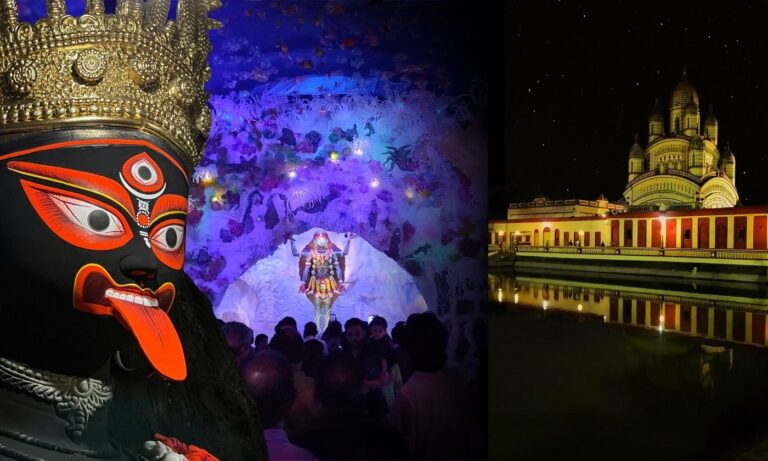
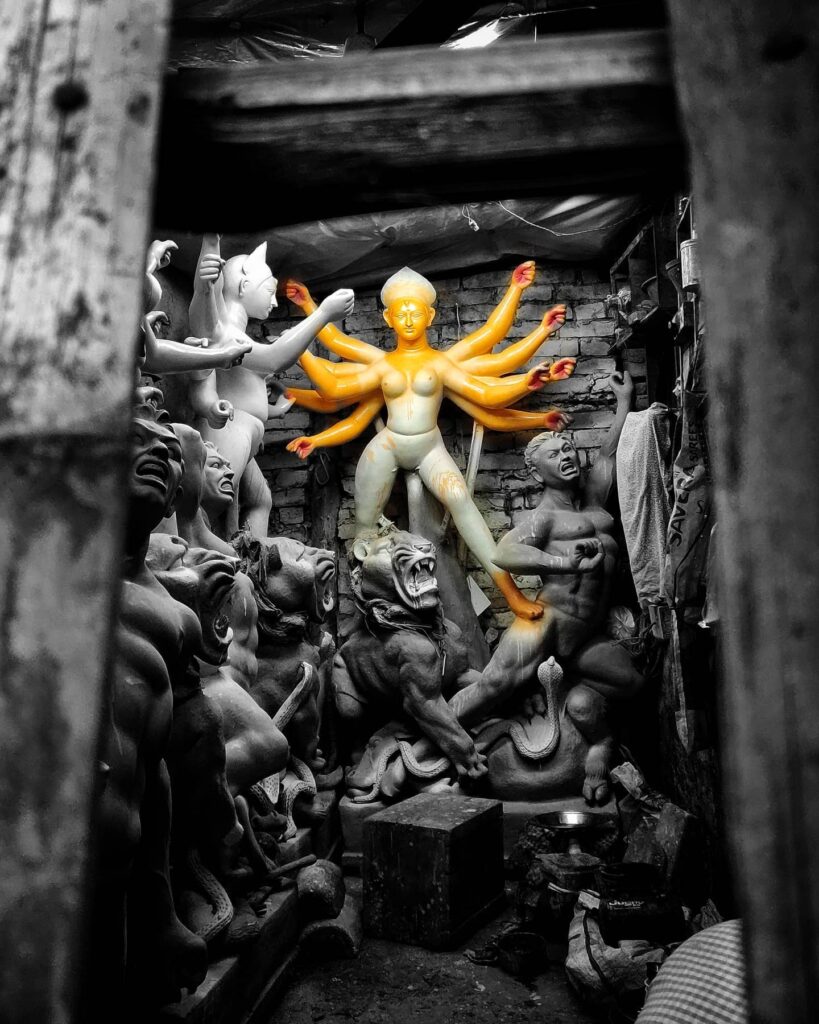
When you stand before Maa Kali’s idol, the first thing you notice is her eyes. They burn with an intensity that feels almost human. Her tongue is red, her garland made of skulls, her skin the color of night itself. And yet, you do not feel fear. The air around her hums with warmth. Devotees call her “Ma,” offering flowers and sweets, whispering their secrets to her. 

You understand then why Bengalis see her not as a goddess of terror, but as a mother who will go to any length to protect her children.

Since Kali Puja rituals begin around midnight, the major temples across Kolkata and West Bengal come alive at the deepest hours of the night. The quiet streets transform as devotees make their way to offer prayers, flowers, and sweets to Maa Kali.

In Kolkata, Kalighat Kali Temple sees a continuous stream of worshippers, its lamps flickering in the dark and chants echoing through the temple corridors. Dakshineswar Kali Temple, part of greater Kolkata, glows softly along the Hooghly River, creating a serene yet powerful setting for midnight devotion. The Thanthania Siddheswari Kali Bari on Bidhan Sarani and Firingi Kali Bari in Bowbazar also attract large crowds, their narrow lanes lit with lamps and filled with the hum of prayers.

Outside the city, temples such as Tarapith Temple in Birbhum become hubs of devotion, with devotees traveling from far and wide to participate in the midnight rituals. 

Beyond the major Maa Kali temples, Shakitpeeths and local Kali temples in every neighborhood come alive as well.

4. The Clay Idols and the Artistic Soul

Walk through the lanes of Kumartuli before the festival and you can smell the river clay. As soon as Durga Puja is over most of the porters start working on Maa Kali Idol.

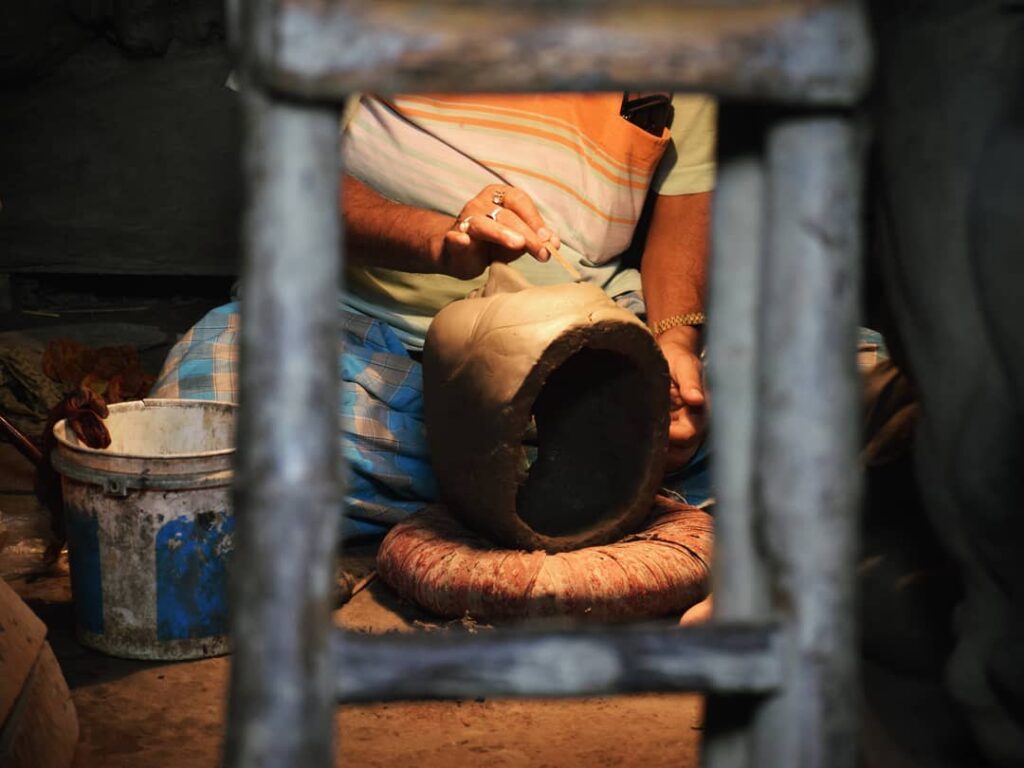
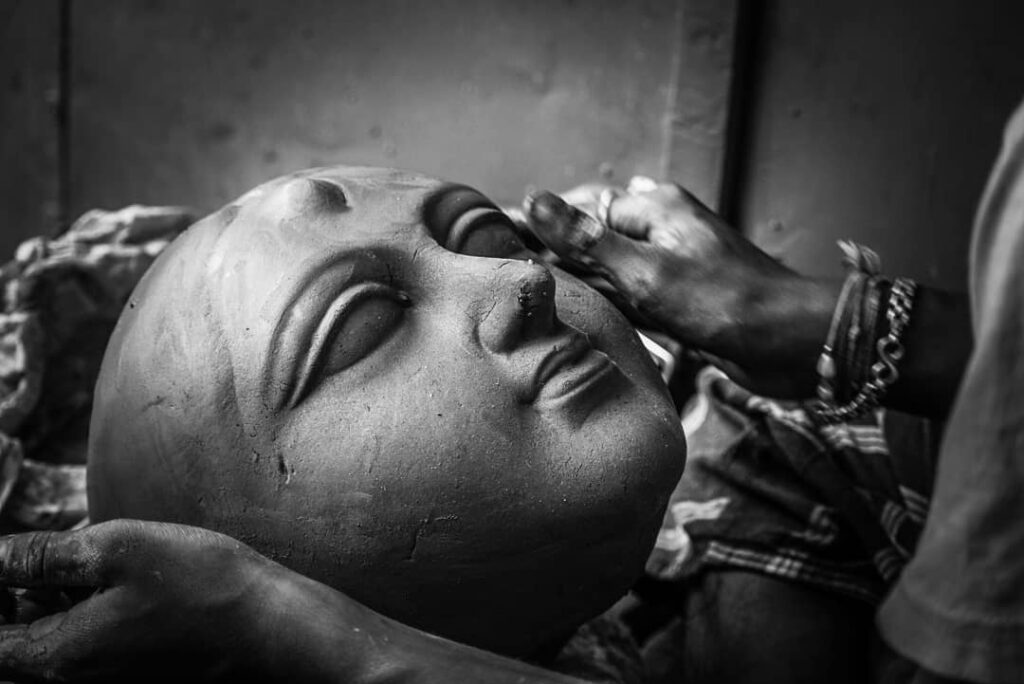
You see artisans shaping faces from earth, their hands moving with quiet devotion. On the night of the puja, these idols come alive under the light of candles and fire. You realize that in Bengal, art is not separate from worship. It is how people touch the divine.

5. Pandal Hopping

A Bengali puja is incomplete without a pandal. It is the heart of the celebration, where art, devotion, and community come together. During Kali Puja, each pandal becomes a small universe of its own. You walk through the decorated streets, and every corner tells a different story. Some pandals glow with traditional grandeur, while others experiment with modern themes, lights, and colors.

In Barasat and Madhyamgram, the pandals are the stars of the night. Families and friends move from one to another, eyes wide with wonder, cameras clicking, children laughing. The sound of the dhak follows you, mingling with chants and the distant fireworks. Every pandal offers a unique experience — some quiet and intimate, others loud and bustling. Each idol seems alive, as if the goddess herself is watching and blessing the visitors.

Walking from one pandal to another, you can feel the pulse of Bengal in the air. The smell of incense, flowers, and fried snacks drifts around you. You see people pausing in prayer, touching the feet of the goddess, offering flowers and sweets. It is a rhythm of devotion, curiosity, and joy.

For anyone visiting Kolkata or nearby towns during Kali Puja, pandal hopping is more than sightseeing. It is a journey into the soul of Bengal, a night where tradition, artistry, and community meet under the glow of countless lamps. The night is long, the streets alive, and the memory of the goddess stays with you long after you return home.

6. The Collective Devotion

If you are in Kolkata or towns across Bengal during Kali Puja, stepping outside after dark is an experience like no other. The streets became alive with people moving from one pandal to another. Many visit temples carrying small offerings of flowers, sweets, or incense. 

The steady beat of the dhak echoes through the air, blending with chants from temples and the occasional burst of crackers in the distance. The sound is rare and not overwhelming, so if you usually fear fireworks, you will feel much safer here.

7. Shyama Puja at Home

Kali puja not only take place in temples and pandals, but also in many households. Just like Lakshmi Puja or Saraswati Puja, many families in Bengal celebrate Shyama Puja at home. This means union of families and friends. They set up a small idol or picture of Maa Kali on a clean altar, decorate it with red hibiscus flowers, lamps, and incense, and offer rice, sweets, and fruits.

8. Experience the Culinary Magic

No Bengali festival is complete without food, and Kali Puja is a true celebration for the senses. The air is filled with enticing aromas from kitchens and street vendors alike, inviting everyone to gather, taste, and share.

9.Art and Culture in the Night

Bengal’s love for art shines during Kali Puja. Community halls, streets, and even open courtyards become stages for music, dance, and theatrical performances. Traditional songs echo alongside modern interpretations, while temporary installations and themed pandals showcase creativity at every turn. 

This celebration of cultural expression adds richness to the festival, reminding everyone that devotion and artistry walk hand in hand.

Diwali Through the Eyes of Maa Kali

In Bengal, Diwali is unlike anywhere else in India. It is a night when the fierce and tender gaze of Maa Kali transforms ordinary streets into a living celebration. From quiet home pujas to grand pandals, from the rhythmic beat of the dhak to the glow of countless lamps, every moment reflects devotion, artistry, and togetherness.

The festival is both intimate and communal. Families share prayers and meals, neighbors exchange greetings, and strangers pause to admire the beauty of each idol. The air is filled with the scent of incense, the hum of chants, and the joy of people coming together. Kali Puja reminds us that worship is not just ritual; it is an experience that awakens the senses, stirs the heart, and unites the community.

For Bengalis, Diwali is not just about lights or fireworks. It is about Maa Kali — her power, her love, and her protection. The night fades, but her presence lingers, leaving behind a sense of awe, devotion, and connection that lasts long after the festival is over.

Loading

Wellness Travel and Fitness Escape: The Next Big Trend?

Digital fatigue is a rising issue in today’s advanced technological world. It’s a big lifestyle-related concern that today’s Millennials realize. Thus, more people are looking for ways to rejuvenate and relax in a highly competitive landscape. This is exactly what has led to the growing popularity of wellness travel and fitness escapes in India.

Of course, the name in itself makes it quite clear that this upcoming trend focuses on the mental, physical, spiritual, and emotional well-being. Wellness travel brings an opportunity to recharge, heal, connect, and return with a refreshed perspective towards life and what’s coming next.

If we look at the statistics, India’s wellness tourism market was valued at $21.23 billion in 2024, which is now expected to reach $39.85 billion by 2034. The numbers in themselves show the significant shift towards health-conscious vacations.

Together let’s explore why this new trend is gaining momentum and how you can plan the perfect wellness getaway!

What is Wellness Travel?

Wellness travel focuses on improving one’s overall well-being. It combines health-focused activities, including yoga, spa treatments, meditation, therapeutic practices, and eco-friendly adventures

An interesting part is the concept is not as new as you might think because wellness travel has its roots, which can be traced back to ancient times when the world understood the healing powers of nature.

Unlike traditional tourism, the main goal is personal growth and rejuvenation, emphasizing self-care to combat daily stress and restore balance.

Popular Style Wellness and Fitness Travel

Travel is not just about ticking off destinations from your list, but many people now look for trips that help them recharge their mind, body, and soul. From yoga retreats in the hills to boot camps on the beach, the options are inspiring as well as refreshing.

1. Yoga and Meditation Retreats

Yoga retreats are the heart of wellness travel. The daily yoga sessions, mindful living, and guided meditations calm you down, helping you improve your focus. Travelers often choose destinations like Rishikesh, Bali, or Costa Rica for the natural beauty that enhances the experience. These retreats help you find the balance, reduce stress, and build inner peace.

2. Fitness Boot Camps

Fitness boot camps are great for those looking for an active holiday. The programs included in fitness boot camps mainly focus on cardio workouts, strength training, and group challenges. Such programs push you to stay active while meeting like-minded people. You might find yourself working out in the morning and enjoying a healthy meal by sunset—both feel like a discipline and an escape.

3. Adventure and Active Escapes

If you are an adventure lover, you sure turn your vacations into fitness escapes. Whether trekking in the Himalayas, cycling through the countryside, or surfing in Bali, these trips challenge your body while rewarding you with stunning views and cultural experiences. This makes the journey truly unforgettable.

4. Spa and Detox Retreats

Spa and detox retreats provide a slower pace, helping you enjoy different types of therapies, including massages, hydrotherapy, and natural healing treatments. Along with this comes clean eating an a detox plan designed by experts to refresh the body. Ayurveda retreats in Kerala and spa resorts in Thailand are great for such experiences.

5. Digital Detox Holidays

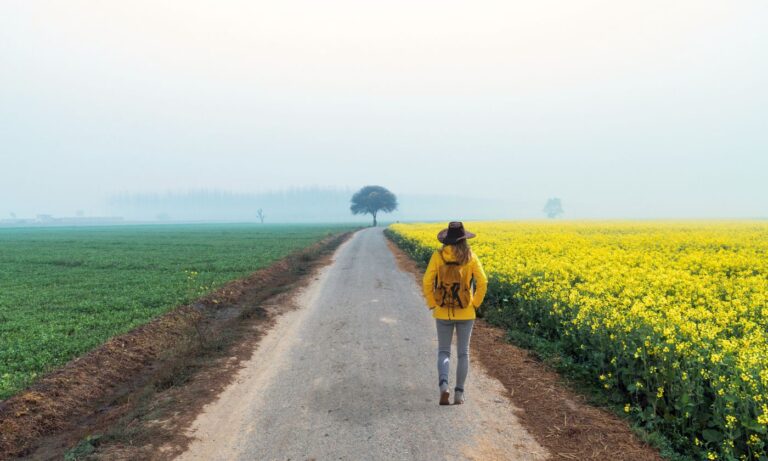
Facing screens for prolonged hours? In our screen-heavy lives, switching off has become a complete luxury. Digital detox trips invite travelers to put their phones away and reconnect with nature. Be it in a quiet cabin or a beach hut or a mountain stay, these escapes give time for long walks, real conversations, and reflection.

6. Nutrition-Focused Travel

Ever heard of nutrition-focused wellness trips? This combines travel with cooking workshops, organic farm tours, and meals designed to energize and heal. Travellers learn about mindful eating and food practices. From Mediterranean diet retreats in Greece to farm-to-table experiences in Italy, these journeys feed both appetite and knowledge.

Why are Fitness Holidays Trending in 2025?

Instead of returning home sluggish, travellers on fitness holidays come back feeling re-energized. Let’s see why fitness escapes are transforming vacations:

  • Post-Pandemic Health Priorities: A couple of years ago, COVID-19 made people conscious of their health, which led to great interest in staying active and opting for wellness-focused activities.
  • Experience over Indulgence: Travelers in 2025 and beyond are seeking enriching and fulfilling experiences instead of traditional vacations.
  • Social Media Influence: Instagram is filled with influencers sharing their fitness and training retreats and journeys, which is inspiring the masses to travel and enjoy wellness retreats.
  • Creating Community & Connection: In a way, wellness and fitness holidays have a social aspect as well, with travelers meeting people in different parts of the country and creating lifelong memories.

How to Choose the Right Wellness Travel Style for You?

Now you know that wellness and fitness come in several forms, as mentioned above in the blog. With so many choices today, sure it can feel a little overwhelming to decide which one suits you the best. But the best part is that you don’t need to follow a trend. The ebay journey is the one that matches your mood, lifestyle, and personal goals.

Let’s find it out on a practical guide:

What is Your Goal?

Take a moment and ask yourself, what would you want from this trip?

  • Are you seeking relaxation? (Choose yoga or meditation)
  • Are you pushing your body to return stronger? (A fitness bootcamp would be the best)
  • Are you aiming for cleansing? (Go for digital detox)
  • Are you curious about traditions and culture? (Opt for spiritual wellness journey)

Research the Destination

Travel works best if it matches the environment that supports your intention. Pick a location that inspires you and sets the tone of your journey.

Look at Program Details

Every wellness and fitness program you choose has its own structure and schedule. Match the program that best suits your lifestyle.

Check Credentials

Your experience depends on the trainers and guides. Cehck their background whether they are certified therapist, licensed instructors, or experienced fitness coaches. Seek guest reviews as well–either online or offline. Honest feedback can speak a lot about the program.

Compare Cost and Value

Wellness and fitness travel ranges from being cost-effective to ultra-luxury. Find out what’s included in the travel plan–meals, accommodation, sessions, and more. Check if there are hidden charges. Sometimes a slightly higher cost brings much better value.

Listen to Your Intuition

Facts and reviews matter, but so does your gut feel. If a program excited you, matches your energy, it’s probably the right choice.

Conclusion

Wellness and fitness travel is more than a trend, it’s a movement towards healthier, more conscious living. Whether you want to stretch on a yoga mat in Bali, hike through snow-capped mountains, or detox with Ayurveda in Kerala, there’s a style of wellness travel for every kind of traveler.

Loading

The Lost Art of Doing Nothing: How to Embrace Stillness in a Busy World

When was the last time you left your mobile device and did nothing?

I mean real, honest-to-goodness nothing, like sitting, breathing, and just being?

Chances are, it’s been a while. Maybe months.

We live in a world where being “busy” is a badge of honor. If you are not juggling ten things, hustling towards your goals, or filling every moment with productivity, people think you are merely wasting time. However, the twist is—in our race to do “everything,” we have forgotten how to do nothing at all. This may be costing us more than we realize.

Why Does Doing Nothing Feel So Hard?

Think about your daily life. From the moment you wake up, there’s noise. Your phone lights up with notifications. Emails pile in. Work deadlines loom. Social media scrolls never end. Even “relaxation” often comes with stimulation, watching shows, listening to podcasts, playing games, or endlessly swiping through reels. We’ve become addicted to input. Our brains crave constant stimulation because silence feels uncomfortable. Stillness feels like… well, like we’re missing out.

But here’s the thing, our ancestors mastered the art of stillness. Ancient philosophers, monks, and even everyday folks knew the value of sitting quietly, watching the world, and letting the mind breathe.

Is There Science Behind Stillness?

Yes, there’s science behind stillness, and here’s how it goes:

When you pause, your brain slips into what scientists call the Default Mode Network (DMN). This is the state where creativity blossoms, new ideas connect, and memories consolidate. Stillness lowers cortisol levels, which means less stress, less anxiety, and even better heart health. Resting without distractions helps sharpen focus. Paradoxically, the more you stop, the more productive you become.

In other words, stillness is brain fuel.

The Myth of Doing Nothing

Let’s be real. Many of us think stillness equals laziness. We feel guilty if we’re not doing something useful. This is because we’ve grown up in a culture that glorifies hustle. But pause for a moment. Do you call a field lazy when it lies fallow, preparing itself for the next harvest? Do you call a phone useless when it’s charging? No. Because rest is part of the cycle. Rest is the hidden half of productivity.

How to Relearn the Art of Doing Nothing

If you spend years chasing productivity, sitting still can feel daunting. The good news is that you can relearn it. Think of it like a skill that is gentle, small steps, and a shift in mindset. Here’s how to bring back the lost art of doing nothing:

1. Start Small with Micro-Moments

Doing nothing doesn’t mean you need the entire evening. Doing nothing can start small. Start with a few minutes. Close your eyes, put your phone face down, and just breathe. Notice your surroundings—the hum of a fan, the light on the wall, the rhythm of your breath. At first, you’ll fidget, your brain will scream, “Check your notifications!” But that’s normal. Over time, the silence will soften.

2. Schedule White Space

We schedule everything else, meetings, workouts, calls, so why not schedule stillness? Block a little “white space” on your calendar. Label it simply: Do Nothing. Protect it like any important appointment. Treat it with the same seriousness you would give to a client meeting. This sends your brain a signal that stillness is not optional, but it’s necessary.

3. Disconnect to Reconnect

Most of the time, it’s not silence that feels impossible, it’s silence with a phone in hand. Devices are noise machines, always ready to steal our attention. So try this experiment: leave your phone in another room. Sit by a window or step onto your balcony. Watch the sky shift. Notice how the world moves without your interference. That gentle reconnection with life around you is the essence of stillness.

4. Practice the “Lazy Walk”

Walking is often treated as exercise or commuting. But there’s another kind: the lazy walk. No headphones, no agenda, no destination. Just walk slowly, looking around. Notice the leaves, the pavement, the faces you pass. Let your mind wander aimlessly. Some of your most creative thoughts may pop up here because your brain finally has the space.

5. Give Yourself Permission

This is perhaps the hardest part. Doing nothing can trigger guilt. That little voice whispers, “You should be doing something useful.” Here’s the truth rest is useful. Think of it like charging your phone. You don’t call your phone lazy for being on 2% and plugging in you call it smart. You deserve the same kindness.

Say it out loud if you must: “It’s okay for me to pause. I’m allowed to just be.” Sometimes permission is the bridge between stress and stillness.

The Takeaway

Relearning the art of doing nothing isn’t about wasting time; it’s about reclaiming it. These small practices create breathing room in a noisy world. Start with minutes, not hours. Protect the pause. Watch the discomfort fade and the calm expand.

Because once you master stillness, you realize it’s not empty at all, it’s full. Full of clarity, creativity, and a deeper connection to life.

Loading

The Story of Kumartuli: From Potters’ Village to Global Durga Idol Hub

Kumartuli, a small locality in Kolkata meaning potter’s village.

Ever since childhood I visited this place only once a year, during Durga Puja, when we went to Kumartuli Park and Kumartuli Sarbojonin. While hopping between these pandals, we would pass through Kumartuli.

As we walked by, my uncle would point out the potters busy crafting Lakshmi idols. Why did I specifically mention Lakshmi? 

Because in Bengal, Lakhi Puja takes place right after Durga Puja.

But those were my childhood days. As I grew up, I kept hearing more about this place, and as an enthusiastic pandal hopper with a deep interest in Durga Puja, I became really excited to see and learn how Maa Durga idols are made.

So one fine day I packed my camera and set out to explore. This is where you truly understand the hardships artisans face while creating idols, from collecting clay to shaping it and finally painting it. All this hard work is for just five days of Puja.

Alongside the artisans, you will also find a bunch of photographers like me, busy trying to capture those beautiful moments. You can experience all this when you visit Kumartuli. But Kumartuli is not just about what you see today. It has a story of its own, about how this place came to be, its origin, and some really interesting tales.

Story of Kumartuli.

Kumartuli, as we know it, is the potters’ locality in Kolkata. Every year, just before Durga Puja, people gather here to witness the creation of Goddess Durga. And these days, it has also become a favorite spot for photoshoots, perhaps even more than before.

The Origins – Potters Become Sculptors

The story of Durga Puja in Bengal is as old as the land itself. It’s layered with history, folklore, and politics. 

The first grand worship of Goddess Durga in recorded history is said to date back to the late 1500s, when zamindars of Dinajpur and Malda celebrated the festival in their estates. 

Another tale credits Raja Kangshanarayan of Taherpur or Bhabananda Mazumdar of Nadia with organizing the first Sharadiya Puja around 1606.

However in the 1700s, the small town of Krishna Nagar started getting fame for bringing Maa Durga’s idol to life for the Nadia Raj family of Maharaja Krishna Chandra Ray.

Kolkata as some claim already existed before the British East India company started creating it, it was Kalikhetra, the land of Kali.

The East India Company finally chose to create a settlement by the banks of river Hoogly.

As they started shaping the city, they started organizing the city based on trades, and in this process potters were allotted a place in an area near Shobhabazar, which is known as Kumartuli.

The potters did settle, but they were no idol-makers. Then their livelihood used to depend on other items, like clay pots and utensils.

They were from Kishnagar and as mentioned were known for clay works. The river Hooghly gave them the right clay; the growing colonial city gave them a bustling market.

But what truly changed their destiny was a puja.

A Turning Point – The Puja of 1757

In the year 1757, Raja Nabakrishna Deb of Sovabazar organized a grand Durga Puja at his mansion. It was partly to honor Robert Clive, partly to display the wealth and power of the new Bengali elite who had prospered under Company patronage.

For this puja, he needed skilled idol-makers and so he brought some of the finest artisans from Krishnanagar. Many of them stayed back. But why??

It is because, gradually the popularity of organising Durga puja started growing particularly among the Bengali Aristocratic family, the Zamindars. 

As a result, orders multiplied, and slowly, the settlement of Kumartuli transformed from a colony of potters into a workshop of gods.

Gradually as the time progressed, the potters of Kumartuli perfected their art. 

What some say began as clay vessels became lifelike Durga idols, crafted with straw frames, river clay, and a painter’s devotion. 

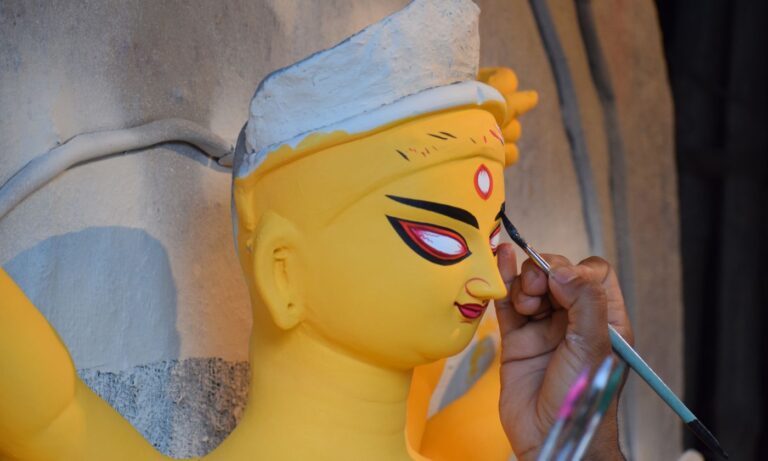
Every year, the lanes filled with half-finished forms of Ma Durga, waiting for Chokkhu Daan; the moment when her eyes were painted, and she came alive.

The location was perfect: soft alluvial clay from the Hooghly, easy transport for idols by boat, and wealthy patrons nearby. Kumartuli became indispensable to Kolkata’s Puja culture.

Evolution of Durga Puja – Changing from Ekchala to Panch Chala

By the 19th century, idol-making had almost replaced pottery as the main livelihood.

Then came a moment of crisis that would change Kumartuli forever. In 1938, just before the Puja, a fire broke out at the Kumartuli Sarbojanin Durga Puja. 

The idols were reduced to ash, and panic spread, how could the festival go on with so little time left?

It was here that Netaji Subhas Chandra Bose, then the president of the Puja committee, stepped in. Refusing to give up, he turned to the sculptors of Kumartuli. 

Among them was the brilliant artist Gopeshwar Pal, recently back from Italy. Faced with impossible deadlines, Gopeshwar Pal improvised.Instead of the traditional ekchala idol (all deities in a single frame), he created the goddess and her children in five separate frames, the Panchchala design.

Obviously people were not happy with it, however Netaji Subhas Bose handled the situation, some said he humorously said that its better for children to stay away when their mother is fighting with the asura. 

This allowed multiple artisans to work simultaneously, speeding up construction. The idols were ready in time, the Puja was saved, and the innovation soon became the new standard across Bengal.

What had begun as a desperate solution in the ashes of a fire became a symbol of Kumartuli’s adaptability.

In the late 20th century, as Kolkata’s pujas turned thematic, Kumartuli’s artists adapted, blending tradition with imagination, from classical clay idols to experimental, eco-friendly, and globally admired designs..

Today’s Kumartuli

Today you’ll find Kumartuli alive, like a breathing canvas.

When you walk through its narrow lanes, clay dust hangs in the air. Unfinished faces of gods and goddesses stare at you from every corner, as if waiting for that first stroke of a brush to open their eyes.

Here, artistry is not hidden away in galleries. It spills onto the streets. You can smell the clay, watch the artisans at work, and witness how each idol slowly comes alive.

Durga Puja is the grandest festival for Bengalis, and in 2021 UNESCO recognized it as an Intangible Cultural Heritage of Humanity. Every year, as autumn arrives, Kumartuli turns into a workshop of miracles. From towering Durga idols that dominate Kolkata’s pandals to carefully packed clay deities sent across the seas to London, Toronto, or New Jersey, the creations of Kumartuli now travel far beyond Bengal.

The same hands that once shaped simple pots now give form to gods who carry the spirit of Durga Puja across the world.

How to Reach Kumartuli?

So, if you’re planning to visit Kumartuli, let me tell you, it’s not hard to find, particularly when everyone carries a smart phone and knows how to use Google maps.

The simplest way? 

You can book a cab. But if you don’t want to spend much and avoid the traffic, then we have Kolkata metro, the oldest in India.

Take the metro. Just get down at Shobhabazar Sutanuti station. From there it’s a ten-minute walk through the lanes of Kolkata. Just as you reach Rabindra Sarani, you can ask a local tea stall about the location, and he will happily guide you.

If you’re in no hurry and want to soak in a bit of nostalgia, hop on a bus along Rabindra Sarani.

And if you want something really special, you can take the ferry. Cross the Hooghly, get down at Bagbazar ghat, and walk into Kumartuli with the river breeze on your face. That’s when you really feel how close this art is to the Ganga’s clay.

But here’s a tip, the best time to go is in the weeks before Durga Puja. That’s when the lanes are buzzing, idols are drying under the sun, and trucks are lining up to carry them off to pandals or even airports. Visit then, and you’ll see Kumartuli at its most alive.

Summing Up.

Kumartuli is more than just an “idol factory.” It is a heritage neighborhood, where tradition and innovation co-exist. Some artisans still swear by the old ekchala idols, preserving the simplicity of centuries past. Others experiment with fiberglass, eco-friendly clay, or themed artistry that reflects modern times.

From fictional grandeur to climate-change awareness, Kumartuli’s idols now carry stories as diverse as the city itself.

But step inside one of the dimly lit studios, and you realise that what hasn’t changed is the devotion. The same river clay from the Hooghly, the same rituals before starting work, the same faith that from lifeless earth, divinity will rise again.

Kumartuli, even today, is not just about making idols; it is about shaping belief, year after year.

And once these idols leave the studios, they bring the magic of Kumartuli to life across Kolkata. From the bustling streets to grand pandals, every Durga Puja in the city becomes a vibrant celebration, a glimpse of which captures the soul of Bengal itself.

Loading

How To Reach Gulmarg From Major Indian Cities

Gulmarg, often touted as India’s winter wonderland, offers a magical blend of snow‑clad landscapes in winter and lush green meadows in summer.

This hill station sits at an altitude of about 8,694 feet (2,650 metres) and is home to Asia’s highest and longest cable ride; the Gulmarg Gondola. It reaches up to 13,780 feet. It has also been consistently ranked among the top ski destinations in Asia.

For every traveller planning a Kashmir trip in 2025, a proper Gulmarg route plan from India is crucial. In this comprehensive guide, I outline step‑by‑step options for reaching Gulmarg from major Indian cities like Delhi, Mumbai, Bangalore, Kolkata, Chennai and beyond. Whether you prioritise speed, economy, or scenic value, this blog equips you with all travel options—flight, train, road—and even budget hacks.

From booking flights to Srinagar airport, planning train journeys to Jammu Tawi railway station, engaging in shared taxi arrangements or self‑drive routes from Srinagar to Gulmarg, the itinerary is exhaustively covered. 

I have also sprinkled a few personal observations from past trips to help you gauge comfort levels, weather timing, and seasonal preparations. At the end, you will have clear clarity on the best way to reach Gulmarg based on your time frame, budget and travel preferences.

Let us embark on this route plan and make your Gulmarg journey as smooth and enjoyable as possible.

Overview Of Route Options For Reaching Gulmarg 

There are three primary routes to reach Gulmarg from India: air + road, train + road, and road only (self‑drive or bus).

  • Air And Road: Fly to Srinagar International Airport and then take a shared taxi or private cab to Gulmarg (50 km approx).
  • Train And Road: Take a train to Jammu Tawi railway station (approx 300 km from Gulmarg via Srinagar), followed by road journey.
  • Road: Direct drive or bus/budget taxi from neighbouring towns or from Srinagar.

Each option has its merits. Flights are faster but costlier, trains offer budget comfort but take longer while roads get scenic but may be challenging in winter. Based on your priorities, time versus money versus comfort, you can choose the optimum route. In sections below I break down each route from major Indian hubs.

Flight And Road Route 

2.1 Reaching Srinagar by Air

Srinagar International Airport (SXR) is well‑connected domestically. Major carriers like IndiGo, Air India, SpiceJet, Vistara and Go First operate regular flights from cities such as Delhi, Mumbai, Bangalore, Chennai, Kolkata and Hyderabad.

  • Delhi to Srinagar: nearly 1.5 hrs direct flight.
  • Mumbai/Bangalore/Hyderabad: mostly connecting via Delhi or occasionally Mumbai, total travel can take 4‑6 hours including lay‑overs.

Booking your flight at least 4 to 6 weeks in advance helps secure good fares. If you travel during winter (December–March), be aware of weather‑related delays.

2.2 From Srinagar Airport To Gulmarg (Approx 50 km, 1.5–2 hrs)

Once you land at Srinagar, there are several options to reach Gulmarg:

  • Shared Taxis: Rs. 600–800 per person; group size up to 5 to 6. Economical during peak season.
  • Private Taxis: Rs. 3,000–4,000 per vehicle up to 4 passengers. Comfortable for families or small groups.
  • Car Rental/Self‑Drive: Available in Srinagar but ensure your rental has snow‑tyre or chains in winter.

The road follows Srinagar as Tangmarg and then Gulmarg. The last 20 km from Tangmarg to Gulmarg is uphill. In winter especially, snow clearance may delay transit, so plan accordingly. Shared taxi drivers typically wait near the airport until you group up, so it is wise to walk out into the taxi stand and ask around rather than relying only on pre‑booked cars.

2.3 Example Route Plan From Delhi

  • Morning flight Delhi to Srinagar (arrive within 11 AM).
  • Quick lunch at the airport (try local food and Kashmiri street snacks).
  • Shared taxi to Gulmarg by 12:30 PM that will arrive by 2:30 PM.
  • Afternoon Gondola ride (if open in season) or sunset at Gulmarg meadows.

Train And Road Route 

3.1 Major Trains To Jammu Tawi Railway Station

For budget‑conscious travellers, especially from eastern and southern India, train travel remains a viable option. Jammu Tawi (JAT) is the nearest broad‑gauge railhead. Notable trains include:

  • Shatabdi Express (Delhi to Jammu, about 9–10 hours)
  • Vaishno Devi Express (Mumbai to Jammu, about 27–30 hours)
  • Himgiri/Andaman Express (Kolkata/Chennai to Jammu, about 32–36 hours)

Advanced reservation (60 days beforehand) is recommended, particularly for AC classes during winter travel.

3.2 Jammu To Srinagar (Almost 300 km by road)

Once at Jammu Tawi, you will need a road journey to Srinagar (6 to 8 hours, 300 km). Options include:

  • Shared Taxi: Rs. 1,200 to 1,500 per person for the Jammu to Srinagar stretch.
  • Private Cab: Rs. 4,000 to 5,500 for a car up to 4 passengers.
  • Bus: JKSRTC and private deluxe buses operate the route that will cost around Rs. 700 to 1,000 but can be uncomfortable with luggage.

3.3 Srinagar To Gulmarg

From Srinagar town or bus stand, you can again take a shared taxi or private vehicle to reach Gulmarg. Total travelling time from Jammu Tawi to Gulmarg can be 10 to 12 hours including breaks.

3.4 Sample Itinerary Bangalore/Kolkata To Gulmarg

  • Day 1: Overnight train from Bangalore to Jammu (32 hrs).
  • Day 3 Morning: Arrive Jammu, break fast at dhaba, then taxi to Srinagar.
  • Day 3 Evening: Stay in Srinagar, enjoy Dal Lake boat ride.
  • Day 4 Early: Shared taxi to Gulmarg; arrive by late morning, begin sightseeing.

3.5 Pros And Cons Of Train And Road Journey

Pros: Cheaper overall, comfortable air‑conditioned sleeper classes.
Cons: Time‑consuming, transit times long, multiple changes. Winter roads can be closed due to landslides or snow, so always check route advisories.

Road-Based Route 

4.1 Self‑Drive Or Private Vehicle

Adventurous travellers may choose self‑drive from Srinagar or nearby towns. From Srinagar, following NH1 and then the Gulmarg route via Tangmarg. In summer, the drive is scenic and manageable.

In winter, roads get icy, and steep sections near Gulmarg require driving expertise and tyre chains. Local vehicle rental agencies provide snow‑kit equipped cars which is highly recommended if you take this route yourself.

4.2 Bus And Shared Taxi Options

There are JKSRTC and private buses from Srinagar to Tangmarg, and then shared taxis to Gulmarg. These buses may not operate every day in winter. Shared taxis are available at Tangmarg taxi stand, cost Rs. 100 to 150 per person for the final leg. From Srinagar Airport or city, shared taxis to Tangmarg cost around Rs. 500 to 700. For passengers travelling light and flexible with time, this mixed option works well.

4.3 Example: Delhi Road Trip

For those who prefer road‑trip style: Delhi to Jammu (less than 800 km, overnight drive), Srinagar via NH44 then Tangmarg and finally Gulmarg. Spread over 2 to 3 days, this lets you explore Jammu city, Vaishno Devi or scenic Kashmir along the way are eye-grabbing. 

4.4 Road‑Trip Tips

  • Check weather forecasts and road‑block warnings.
  • Carry warm clothes, blankets, snacks and water.
  • Keep mobile network or offline map support—network may be patchy.
  • Start early to avoid night driving on steep sections.

Detailed Comparison Of Routes: Time, Cost, Comfort 

Below is a city‑wise comparison showcasing a typical Gulmarg route plan from India, for beginners, backpackers and revisitors. It is viable for using all three options that are air + road, train + road, and road only. Here is a clear understanding: 

Origin City Route OptionApproximate TimeEstimated Cost (Per Person)Comfort Level
Delhi Flight + Road4 – 5 Hours₹ 4,000 – 6000Very Good
Mumbai Flight + Road5 – 7 Hours₹ 5,000 – 7,500Good 
BangaloreFlight via Delhi + Road7 – 8 Hours₹ 6,000 – 9,000Good 
Chennai/KolkataTrain + Road 48 – 60 Hours₹ 3,500 – 5000Moderate (depends on class)
Srinagar Road Only (Shared)1.5 – 2 Hours₹ 600 – 1,000Fair 
JammuTrain + Road10 – 12 Hours₹ 2,500 – 3,500 Moderate

Note: (Costs are indicative and may vary by season, booking time, and transportation choices.)

In my view, the flight and road option, especially from Delhi or Mumbai, is by far the most practical for most travellers, balancing speed, comfort and manageable cost. If budget is the priority and you do not mind longer travel as the train and road route remains popular among Indian travellers, especially students and large families crisscrossing India.

The road‑based option appeals to road‑trip enthusiasts or those already in Kashmir, but it requires more preparation and flexibility.

Practical Tips And Seasonal Insights For Best Gulmarg Tour Planning

Best Time To Travel

  • Winter (Dec–Mar): Ideal for skiing and snow activities, but roads and flights may be delayed due to snowfall.
  • Summer (May–Sep): Pleasant weather, lush meadows, alpine flowers. Roads are usually clear, and travel is smoother.

Early Booking Advice

  • Flights: Book 4 to 6 weeks ahead, especially during winter or summer holiday weekends.
  • Trains: Reserve at least 60 days in advance.
  • Shared Taxis: Available at hubs but during peaks (winter holidays, summer vacations) book private cab in advance.

Health And Safety For You And Your Loved Ones

  • Altitude is not very high as Gulmarg is less than 2,650 metres above sea level. However, if you are prone to motion sickness, the hilly road can unnerve you.
  • In winter, wear layered clothing, carry gloves, socks, thermal wear. Snow boots or good grip shoes help.
  • Keep snacks and water, carry a portable charger because electricity may not be reliable in winter and hilly areas.

Scenic Beauty And Local Experience

  • From Srinagar to Gulmarg road, the views of pine forests, gushing rivers and pastoral Kashmiri villages are unforgettable. In summer, wildflowers bloom along the way.
  • I personally found that breaking a journey mid‑stop in Tangmarg for a Kashmiri tea and walnut cake adds pleasant local flavour.

Ready To Plan For A Gulmarg Trip? 

Crafting your Gulmarg route plan from India involves selecting the travel option that best suits your schedule, budget and travel preferences. For most Indian travellers, a flight to Srinagar followed by a shared or private taxi to Gulmarg is the fastest, most reliable option. It offers both comfort and scenic delight, whether you visit in winter or summer. 

Meanwhile, the train and road route appeals to those seeking affordability and are comfortable with longer travel times and multiple transit segments.

If you are already in the Jammu‑Srinagar region, or are inclined towards road‑trip adventure, the road‑based option offers flexibility and scenic rewards, especially in favourable seasons.

I recommend booking transport (flights, trains or shared taxis) well ahead, especially in ski season or peak summer. Always keep current route advisories, weather updates, and travel insurance, especially during snowfall.

Small personal suggestions: stop for a local Kahwa tea at Srinagar airport or spend a night in Srinagar to enjoy Dal Lake before heading up.

With clear route planning, from flight corridors to train coaches to shared taxi logistics, you are fully equipped to traverse the snow‑covered slopes or emerald meadows of Gulmarg.

Whether aiming for skiing in March or enjoying alpine blooms in June, your journey from any Indian city to Gulmarg will be smoother with this route plan in hand. Safe travels, and may your Kashmir experience be as enchanting as the destination itself.

Frequently Asked Questions (FAQs) 

  • How can I reach Gulmarg from Delhi?

You can reach Gulmarg from Delhi by taking a direct flight to Srinagar International Airport, which takes around 1.5 hours. From Srinagar, you can hire a shared taxi or private cab to cover the 50 km journey to Gulmarg. The road trip offers scenic views and usually takes about 1.5 to 2 hours.

  • What is the best way to travel from Jammu to Gulmarg?

The best way from Jammu to Gulmarg is by train or bus to Jammu Tawi railway station, followed by a road journey to Srinagar, then onward to Gulmarg by taxi or shared cab. This route can take around 10 to 12 hours but is cost-effective and offers a chance to enjoy Kashmir’s picturesque landscapes.

  • How far is Gulmarg from Srinagar, and how long does it take?

Gulmarg is approximately 50 kilometers from Srinagar. The road journey takes about 1.5 to 2 hours depending on traffic and weather, especially during winters when snow may slow travel. The route is scenic, passing through Tangmarg and beautiful pine forests, making it an enjoyable ride despite occasional delays.

  • Are there shared taxis available to reach Gulmarg?

Yes, shared taxis operate regularly from Srinagar and Tangmarg to Gulmarg. They are a popular budget option among tourists and locals alike, typically costing less than private cabs. However, availability may be limited during off-peak seasons or heavy snowfall, so it is advisable to plan accordingly or book private transport during winter.

  • What is the cheapest way to reach Gulmarg from India?

The cheapest way to reach Gulmarg is to take a train to Jammu Tawi followed by a road journey via Srinagar using shared taxis or buses. While it takes longer and involves multiple transfers, it is budget-friendly compared to flying directly to Srinagar and then hiring private cabs.

Loading

My Journey Through Coastal Karnataka: A Land of Hidden Charms

0

Traveling, in my opinion, is about more than just crossing places off a list. It’s about those unforeseen moments, like the fragrance of damp soil after the first rain, the impromptu discussion with a stranger, or the warm cup of chai at a roadside shop. And during the 2024 monsoon, my heart guided me to Coastal Karnataka, a region I had only ever seen on postcards.

I didn’t have a big plan. No ten-day schedule with locations and times color-coded. “I want to see the sea in the rain,” was all that came to mind. And I did precisely that.

The First Sight of the Arabian Sea

Mangalore, a city that smells of the ocean and coffee beans, is where my trip started. The rain came in sheets so heavy that the platform resembled a moving picture, and the sky was a heavy blanket of gray as the train rolled in. To go to my hotel close to a beach, I drove. The driver kept telling me on the way that the sea was “angry” during the monsoon, but I believe he was exaggerating.

That first evening, I walked down to the beach, barefoot. The sand was damp, cool, and peppered with tiny shells. The waves crashed with a rhythm that felt both chaotic and calming. There were no tourists with selfie sticks, no beach shacks playing loud music. Just fishermen pulling in their nets, their silhouettes sharp against the fading light.

I sat there for hours, watching the tide rise, feeling the mist stick to my skin. I knew then that this trip would be about slowing down.

Taking a Bus Ride

I got on a rickety local bus that was going south toward Udupi the following morning. A bus full of schoolchildren, vegetable vendors, and drowsy office workers is, in my opinion, the best way to get a sense of a town. The air smelled of fresh jackfruit and damp raincoats, and the windows were foggy.

Coconut groves, flooded paddy fields, and small temples painted in vivid reds and yellows were among the constantly shifting landscapes outside as we drove. Every time we came across a river, it was aThe Island That Called Me and Maple Beach.

Malpe Beach and the Island That Called Me

Malpe Beach in Udupi isn’t the most peaceful location; it’s crowded, well-liked, and frequently lined with food vendors offering fried fish. I observed the fishermen fixing their boats as I strolled along the shore. I was then informed that St. Mary’s Island was only a short ferry journey away.

Regretfully, the ferry does not operate during the monsoon. I stood on the beach, disappointed, looking at the island’s dim silhouette in the distance. Desiring to go there but being unable to do so also had a certain beauty. I made a self-promise to go back during the dry season.

Food That Feels Like Home

Food in India is more than simply food; it’s a hug on a plate, as anyone who grew up there knows.I ate one dosa after another for the whole afternoon while I watched the rain outside a small restaurant. The proprietor, a gracious woman in her 50s, insisted that I had more food. My heart was as full as my stomach by the end, but I was scarcely able to move.

The Road to Gokarna

I traveled north to Gokarna by train from Udupi. The journey through lush forests, rivers, and cliffs, made the trip itself a delight. The hills in Gokarna have been rendered an unattainable shade of green by the rain.

Om Beach, Kudle Beach, and Half Moon Beach are the beaches that most people associate with Gokarna. Swimming is dangerous during the rains, so I chose to explore the town instead. The narrow lanes were lined with old houses, each with a red-tiled roof and a verandah dripping with rainwater.

I also went to the Maha Ganapati Temple, where the sound of bells and incense filled the air. Life here has a slower cadence. Even the store owners appear unhurried, happy to sit and converse over endless cups of tea.

One of my favourite days in Gokarna wasn’t about any landmark at all. I simply wandered — down dirt roads, past small farms, into forests where the only sounds were the chirping of insects and the occasional call of a bird.

I met a farmer who offered me freshly cut coconut. We stood under a tree, drinking the sweet water, talking about the weather and the price of rice. Neither of us asked the other’s name. At that moment, it didn’t matter.

That’s the thing about travel, the best memories are often born in moments you couldn’t have scheduled.

The Return Journey

When I finally boarded my train back to Mangalore, I felt the familiar bittersweet pull of leaving a place you’ve just started to understand. Coastal Karnataka had given me more than I expected, not in terms of attractions, but in quiet experiences.

I had seen seas that roared and whispered, eaten food that felt like family recipes, and met people whose kindness was effortless. I had learned to walk slowly in the rain without rushing to find shelter.

If you’re reading this in 2025 or beyond, wondering where to go next, maybe don’t chase the “best season” or the “most popular spot in India.” Instead, follow something smaller, a craving for rain, a whisper of the sea, or the promise of a plate of dosa. You might just find a trip that lingers long after the photos fade.

Share your unforgettable trip with us and let’s witness the beauty of India together.

Loading