


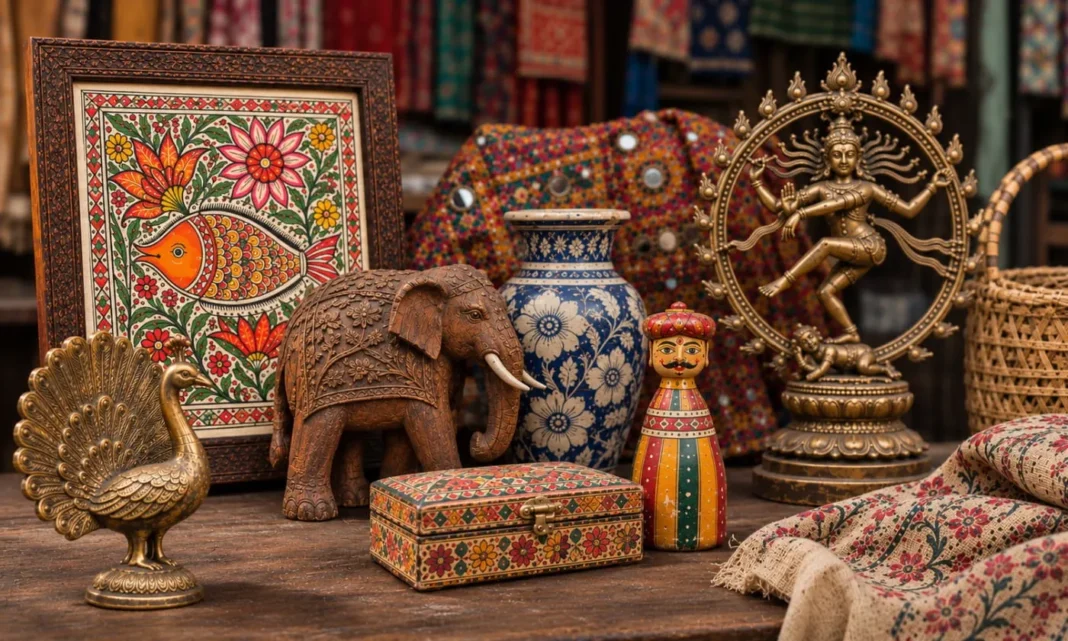
Would you recognise a region in India just by looking at the colours, patterns, and the technique in its handicrafts?
A Madhubani painting won’t look anything like a Kashmiri papier-mâché box. Phulkari stitching carries its own identity, just as the Channapatna wooden toy does. If you put the two together, you have an interesting portrait of India: one nation, but no unified concept of what is considered artistic.
This is what gives regional crafts their importance. They aren’t just different products being made in different regions of the country. Crafts give an insight into the taste, environment, skills, and experiences of the people creating them.
Take a closer look at a traditional craft and many things will become noticeable, like:
Why is there a preference for beautiful floral embroidery in one region while other regions excel in geometric motifs?
Why do some artisans work with bamboo and cane while others put in hours making metal shapes, dying cloth and painting scenes on them?
All of this has a meaning. And it gives quite an intriguing insight into the cultural diversity of India without going into a history textbook or reciting a list of regional crafts.
Why Each Indian Region Sounds Unique?
Take crafts to be dialects. Both Bengalis and Punjabis talk about the same world, but the words, the tempo, and the humour vary. The four things that determine the dialect of the craft include:
- Materials: Bamboo for Northeast, wool for Kashmir, brass for Moradabad, sandalwood for Mysore.
- Climate: Hot and dry zones prefer lightweight fabrics like cotton and bright hues. Colder places prefer wool, embroidery, and layers.
- History: The history of kings, trade, and invasions finds its reflection in patterns and techniques.
- Religion and Rituals: Several crafts originated during festivals, weddings, and worships before becoming products.
Remember these four things. They account for almost everything you will learn below.
A Journey Across India Through Its Regional Crafts
Now you know that every region in India has its own artistic language, which can be seen in the patterns of the fabric, colours, and even little details. Let;s travel through some of India;’s well-known craft traditions.
- North India: Fine, Soft, Detailed
Kashmir is known for producing the finest wool known as pashmina that can run through a ring. The weaving done there is done according to a coded pattern, with each thread being counted manually. One shawl may take months. Wood-carving using walnut wood along with papier-mâché, which is painted with gold and red colors.
Further south in Uttar Pradesh, chikankari of Lucknow uses white thread on white fabric in shadow work.
- West India: Loud, Bright, Proud
There is nothing about whispers in Rajasthan or Gujarat. Bandhani from Gujarat comes with many thousands of dots, each of which was created through tying the fabric by hand before the dying process took place.
Bagru and Sanganer prints of Rajasthan involve floral patterns being printed on fabric using natural dyes. The embroidery in Kutch involves mirrors stitched on the fabric for both decorative and protective purposes.
The blue pottery of Jaipur is quite surprising. This type of pottery uses neither clay nor any other earth material; it is made of quartz and glass.
- East India: Storytellers
Kantha of Bengal was an economical technique. Old saris were used and women joined them by stitching through running stitches. These stitches gradually turned into the forms of birds, fishes, and village life. Terracotta horses and temple tiles of Bishnupur are another example of instinct for story first.
Odisha does this on paper and palm leaf. Pattachitra painters of Raghurajpur paint mythological stories in thick lines and reddish colors. Higher up, Madhubani paintings of Bihar are patterned right down to the last inch.
Then there is Dokra, which is a lost wax metal casting art practiced throughout Bengal, Odisha, and Chhattisgarh. Each Dokra creation is unique since the mold breaks while removing the creation from it.
- South India: Rich, Ordered, Ancient
South India cherishes its gold, temples, and symmetries. The Kanjeevaram silk saree has borders from temples and heavy zari. The Thanjavur painting consists of gold leaf and semi-precious stones superimposed on rich blues and reds. In Swamimalai, even today bronze idols are crafted following the method used a thousand years back by Cholas.
In Karnataka, things have a whimsical touch. The brightly and safely coloured Channapatna toys are the specialty of the town that has made them through the generations. Bidriware – inlaid dark metal with silver looks like starlight on charcoal – originates from Bidar.
In Kerala, Aranmula kannadi is a unique handmade metal mirror crafted by some families following the formula of an alloy secreted through generations.
- Northeast India: Natural, Geometric, Earthbound
Here bamboo and cane reign supreme. Baskets, stools, and ornamental pieces are woven with precision by artists in Assam, Tripura, and Nagaland.
Assam’s muga silk is naturally golden in colour and gets darker with every wash. Naga shawls are made of red, black, and white stripes and sometimes the pattern reveals the community which made them. The Longpi black pottery of Manipur is wheel-free and smoked.
Pattern Recognition Test
The next time you find yourself walking through a market or museum or scrolling, take this easy test in less than ten seconds.
- Check the base material: Cloth, clay, metal, wood, paper, or bamboo? The material can instantly point towards the geographical location.
- Check the color scheme: Earthy and subdued colors will be found in eastern or southern regions, while bright neon colors are usually found in western regions.
- Check the motifs: Birds and fish suggest Bengal or Bihar, geometrical stripes suggest northeast, temples and elephants suggest southern regions.
- Check the texture: Smooth and symmetrical or rough and handcrafted?
Note: You won’t always be right. That’s fine. Even experts argue about where one tradition ends and the next begins, because crafts travel with people, marriages, and trade.
Why We Should Pay Attention To These Traditions
Traditions of regional handicrafts are valued more than their aesthetical appeal; however, there is more to that.
Traditionally, artisan crafts are a means for supporting one’s family, keeping up specialised skills, and contributing to the economy of local communities. Moreover, these practices preserve cultural heritage of regions since they are often passed down from generation to generation within families.
However, it is sometimes hard to practice traditional craftsmanship due to various reasons like lack of access to the market, changes in consumer demands, machine-made products being cheaper, and receiving fair prices for work.
Awareness and respect become highly important. Buying a genuine product, understanding its background, and appreciating people’s labour may provide additional attention for artisan communities.
Next time you will notice something crafted by hand, try to learn more about it. Try to think of where this craft originates, who made it, and what is unique about its technique. You will discover an interesting story behind it.
Concluding Note: One Country, Countless Stories to Unfold
Regional handicrafts of India tell us that there isn’t one language of innovation. Creativity takes varied forms depending upon its birthplace, its practitioners and the cultural legacies they bring.
While Punjabi embroidery and Bihar’s paintings add their elements to the artistic tapestry of the country, there is also the metal craft of Karnataka and the bamboo crafts of the Northeast.
However, these aren’t just remnants of history; they keep growing with artisans’ experimentation with newer designs and the changing markets as well as the changes in lifestyle.
Knowing where a craft comes from makes us appreciate it differently. But there’s another side worth understanding: the effort involved in keeping these skills alive.


