


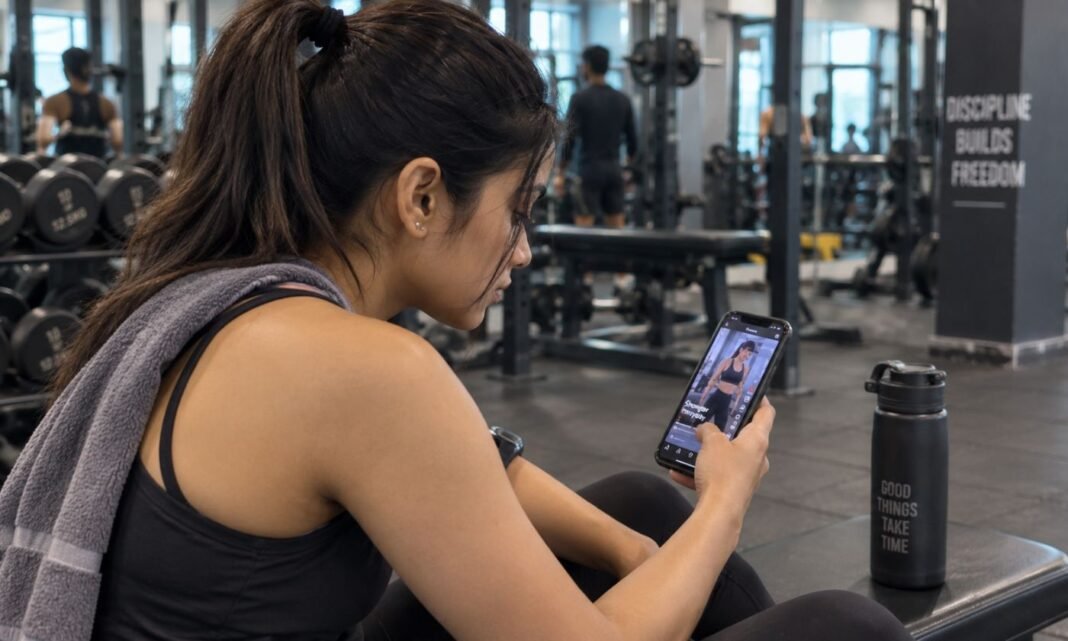
You open Instagram for five minutes and somehow end up watching workout routines, meal-preps, 30-day challenges, running transformations, and people talking about they never miss a workout.
At first, it can be inspiring. You think that maybe you should start working out again. Or perhaps you save a few exercises, plan your meals for the week, and feel ready to get back into a routine.
However, after a while, something changes.
In addition to encouraging you to exercise, fitness posts might make you feel like you are not working out enough. You begin comparing yourself to other people, feeling bad for taking a break from exercising, or wondering why your achievements don’t look like all those transformations online.
The change in attitude towards social media from one of inspiration to one of stress is something you should definitely consider.
Social networks can positively influence healthy behavior, but they can also redefine what fitness means to you.
How Social Media Can Motivate Healthy Fitness Habits?
First things first, because the social media fitness movement isn’t the evil villain origin story.
It was often the first time many people saw themselves reflected in a lifter, runner of a 5K, or person who showed up regularly and wasn’t an exception genetically.
Free workouts, exercise form pointers, nutritional advice, all of the information that had previously required the fee of a personal trainer per hour became accessible through scrolling.
Challenges helped get people started on their fitness journeys, progress updates kept them motivated to continue.
There’s an element of this system that is really good for people. Community, motivation, evidence that change is possible despite it being slow. That element still exists. It’s just really difficult to locate.
How Social Media Algorithms Shape Fitness Content?
This is the part of downloading an app that they never tell you: what the algorithm is showing you isn’t necessarily useful, it’s effective. And the more dramatic, the better. The more shocking and extreme and unattainable, the more effective it is. And it doesn’t matter how much more effective it is to actually watch someone properly performing squats for 45 minutes, that simply won’t be as effective, no matter how true that is.
So the algorithm favors the exception, the aesthetic, and the quick, and you end up measuring yourself against someone who is in peak condition in their best-lit 15 seconds against your own.
Tuesday, which involves being tired, slightly bloated, and just managing 30 minutes at the gym. This is not a fair fight, and it was never meant to be one.
It’s not even just about appearance anymore. Now everything has to be optimized: your macro-nutrients, your recovery, your supplements, your sleep score.
Health begins to seem like something you can never quite get right.
How Social Media Fitness Content Can Affect Your Mental & Physical Well-Being?
The comparison trap is not an online one only, it also follows you to the gym, to the kitchen, to how you relate to yourself. This is where the issue becomes apparent:
Working Out Due to Guilt
Not because it makes you happy, but because you fear missing the chance to exercise.
Resting Days Become a Moral Matter
Not taking a day off to recover and rest, but seeing a break as falling behind others’ streaks.
Orthorexic Tendencies
Worrying about eating “wrong” rather than using tracking apps to keep yourself informed and healthy.
Body Image Takes the Hit First
Your perception of what is “normal” subtly changes to that of a feed composed of the best 1%.
Actual Progress Does Not Seem Like One
Real growth feels insignificant compared to the highlight video of others.
Who is Most Affected by Social Media Fitness Pressure?
Not everyone absorbs this the same way. A few groups are more exposed than others:
Teenagers and People in Their Early 20s
This is the demographic with the weakest real-life experiences to counteract what they see in social media. The person in their thirties, who has spent ten years of their life training in actual gyms, knows right away when they see something out of the ordinary or manipulated.
A sixteen-year-old scrolling through the same content, on the other hand, lacks this filter. Whichever picture is seen most times in the feed becomes the new standard without any authority telling them “by the way, this isn’t normal.”
New Members to the Gym
These people are particularly vulnerable since their mental expectations from their first few workouts are built based on edited content prior to them getting in the actual gym.
They will be expecting rapid results, perfect form and constant energy.
Reality comes and shows them sore joints, gradual progress and days where they lack motivation, thus proving to them that they are not doing it right, despite everything being fine.
Men, Increasingly
For a very long time the problem was discussed in terms of female and body image issues exclusively, however that is changing.
The men of today find themselves in similar situations to the one experienced by women, under the influence of the same algorithm and with the same comparison trap. It is as artificial and potentially harmful and receives a fraction of the attention and even less worry about it.
Anyone Who Is Coming Back
Coming back after some time off is not an easy thing on its own, yet it is made harder by the presence of social media.
While rebuilding oneself both physically and mentally, the individual compares himself or herself to someone who posted his or her best workout yet while they are on day one of their comeback attempt. It is an unfair comparison, but the brain doesn’t do the math at midnight.
How to Build a Healthier Relationship with Fitness Content?
None of it suggests that one should abandon the use of social media or stop consuming fitness content in general. All it suggests is becoming a lot more thoughtful regarding what goes into their feed, since currently, most of the time, a person’s feed was curated by an algorithm, and not by a human.
Unfollow any account that leaves you feeling bad regardless of how great the content may be, you will know which ones are, because you already feel that way.
Follow accounts that focus on process rather than aesthetics and show all that hard work that goes between starting out and getting results.
Find something that doesn’t involve scales and mirrors as much, that isn’t easily photographed.
Can you carry groceries up four flights of stairs? Are you sleeping better? Are you full of energy at 4 pm? This kind of progress does not fit into any photographs, and this is precisely the reason why it doesn’t clog one’s feed, but it’s real.
And lastly, one can try something very simple that surprisingly works really well. Just put one’s phone aside before working out.
Fitness Should Motivate, Not Pressure You
That 11pm scroll isn’t going anywhere, and honestly, it doesn’t need to.
The fix was never “delete the apps.” It’s remembering that motivation is supposed to come from inside your own routine, not from someone else’s highlight reel. The moment fitness content starts making you feel smaller instead of stronger, it’s stopped doing its job, and you’re allowed to just stop watching.


