



Most of us head to Puri for the crashing waves and the divine blessings of Lord Jagannath. I did exactly that on a recent trip, but this time, I decided to look beyond the usual itinerary.
Approximately 15 kilometers from the bustling temple town lies a place that feels like a portal to another era. It’s called Raghurajpur, and if you are fascinated by Indian mythology and raw, unfiltered culture, you will love this heritage crafts village.
It is not just a tourist stop; it is the beating heart of ancient artistic traditions, and an absolute paradise if you enjoy capturing life through a camera lens.
Walking Through an Open-Air Gallery
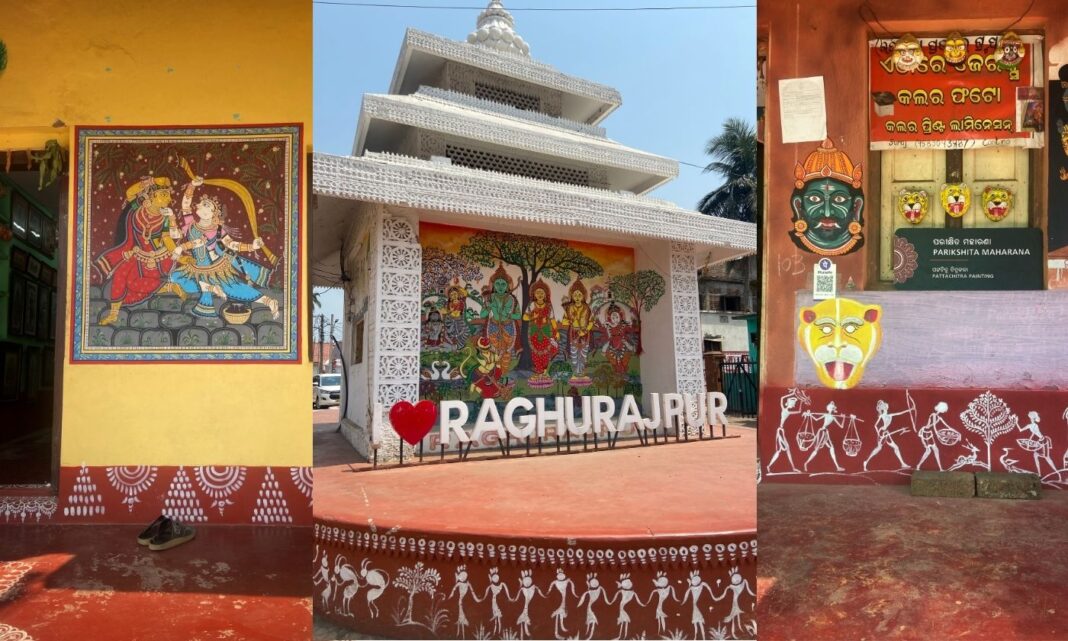
Imagine walking into a village where every single house is an art studio. I did a slow walk down the two main streets, surrounded by lush coconut and jackfruit trees, and the visual overload was incredible.
The outer walls of almost every home are living canvases, painted with vibrant murals depicting scenes from Jagannath Temple, Rath yatra, the Ramayana, the Mahabharata, and the playful folklore of Lord Krishna.
You should take your time exploring these streets. I did like this: I arrived in the afternoon, when the village had slipped into a quiet siesta. But not everyone was asleep. An artisan, perhaps keeping an eye out for the occasional wandering visitor, spotted me before I spotted him. Before I knew it, he was walking me toward his workshop.
Now, I will be honest. I am usually the kind of traveller who likes to explore alone, at my own pace, without anyone guiding me toward anything. But something about the way he carried himself, unhurried and genuinely proud, made me decide to follow. And that turned out to be one of the better decisions I made that afternoon.
Raghurajpur is known for two distinct art forms. The first is Pattachitra, the ancient scroll painting tradition that fills every wall and workshop in the village. The second is Gotipua, the centuries-old acrobatic dance form that this village gifted to the world and that directly inspired the birth of classical Odissi dance.
Photography Note
Most artisans are happy to be photographed at work — just ask first and let them invite you in. That simple courtesy opens more doors than any amount of wandering alone.
The Magic of Pattachitra
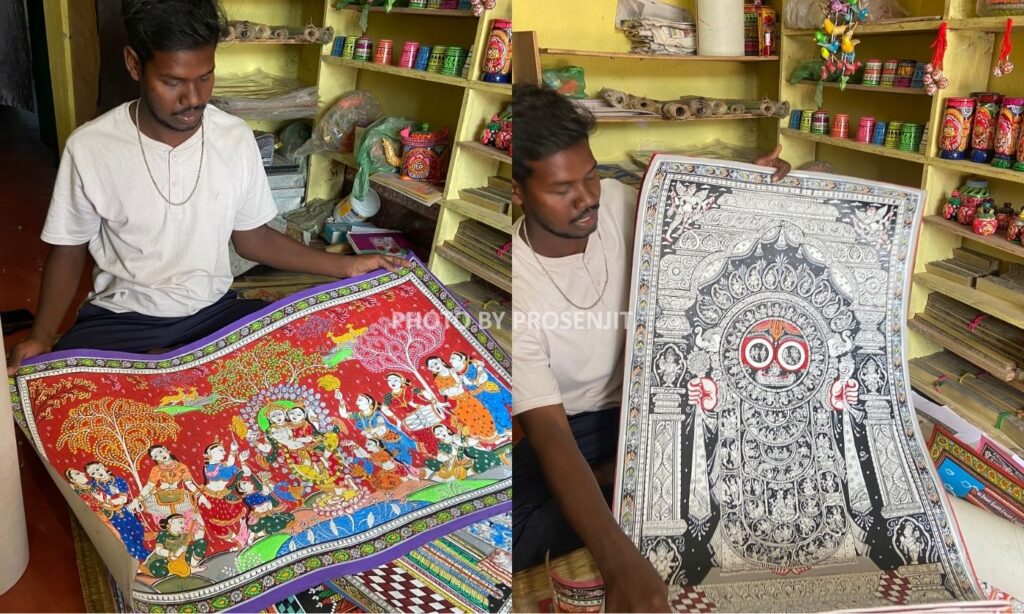
The undisputed soul of Raghurajpur is Pattachitra. For those who might not know, “Patta” means cloth, and “Chitra” means picture. This ancient scroll painting tradition dates back to the 12th century and is deeply tied to the rituals of the Jagannath Temple.
What you will love about this craft is the uncompromising dedication to the old ways. The artists do not rely on digital prints or synthetic colors. I sat beside a local artisan and watched as he explained the process—the brilliant white comes from crushed conch shells, the deep blacks from lamp soot, and the vibrant reds and yellows from local stones.
Seeing this spiritual art come to life right in front of you is a masterclass in patience. I asked him exactly how much time goes into a piece. He told me that just preparing the traditional canvas takes several days. A standard painting takes him 5 to 15 days of solid work, while the highly intricate, large-scale masterpieces can take 25 to 40 days, or even months to complete!
He even showed me some Pattas. Now the question arises how is this patta prepared?
How the Artisans Prepare the Patta for Pattachitra?
He explained that preparing “Patta” is an exhaustive, multi-day process in itself:
- The Base: It starts with soft, old cotton cloth, often worn-out sarees that absorb natural mixtures better than crisp, new fabric.
- The Natural Glue: Tamarind seeds are soaked, crushed, and boiled over a fire into a thick, sticky paste.
- Layering & Coating: Two pieces of the cotton are glued tightly together using the tamarind paste. It is then coated with a mix of the paste and chalk powder to seal the fabric so the paint won’t bleed.
- The Final Polish: After drying in the hot sun, the canvas is vigorously rubbed—first with a rough stone to level it out, then with a perfectly smooth stone until the surface feels glossy and sturdy, almost like fine leather.
How Much Does a Pattachitra Cost?
As someone well acquainted with the painting I was aware of the prices. But I still asked about prices — I was thinking of buying a few pieces.
He explained that pricing depends on the painting, a simple piece that takes around 7–15 days may cost ₹1,000, while highly detailed masterworks, that take weeks and even months, start from ₹5,000 and can go into lakhs.
Hearing it directly from him made me realize you aren’t just buying a painting; you are paying for weeks of someone’s life and centuries of heritage.
One thing worth keeping in mind: these prices are fair and reflect real labour. Bargaining aggressively here feels wrong in a way it doesn’t at a market stall. Pay what the work is worth.
Tala Pattachitra and What You Should Buy
While the cloth scrolls are famous worldwide, you should definitely keep an eye out for Tala Pattachitra, or palm-leaf engraving. This is a delicate, almost microscopic art form. Strips of palm leaves are sewn together, and the artist uses an iron stylus to scratch intricate mythological scenes onto the surface. Some of these palm-leaf creations even feature small “windows” that you can fold back to reveal a hidden deity underneath!
Alongside these, the village produces beautiful papier-mâché toys and masks portraying fierce demons and benevolent gods. When you visit, you should do a bit of souvenir shopping. Buying a piece of art directly from the creator’s porch feels incredibly special, and it directly supports the community keeping these traditions alive.
Gotipua: The Dance That Raghurajpur Gifted to the World
I did not hear the ankle bells that afternoon. I did not stumble upon a courtyard rehearsal or watch boys bend themselves into impossible shapes under the Odishan sun. But the moment I walked through Raghurajpur, I knew exactly what this village meant to the world of performing arts. You do not spend almost half your life in Odisha without Gotipua finding its way into your story somehow.
I still remember the afternoon one of my school teacher who was teaching Sahitya, paused mid-lesson, completely unprompted, and said something that has stayed with me ever since. She told us that in Odisha, even the boys learn to become the goddess. Not as performance. Not as costume. But as devotion. I was too young then to fully understand what she meant. Standing in Raghurajpur years later, it finally made sense.
What Is Gotipua Dance?
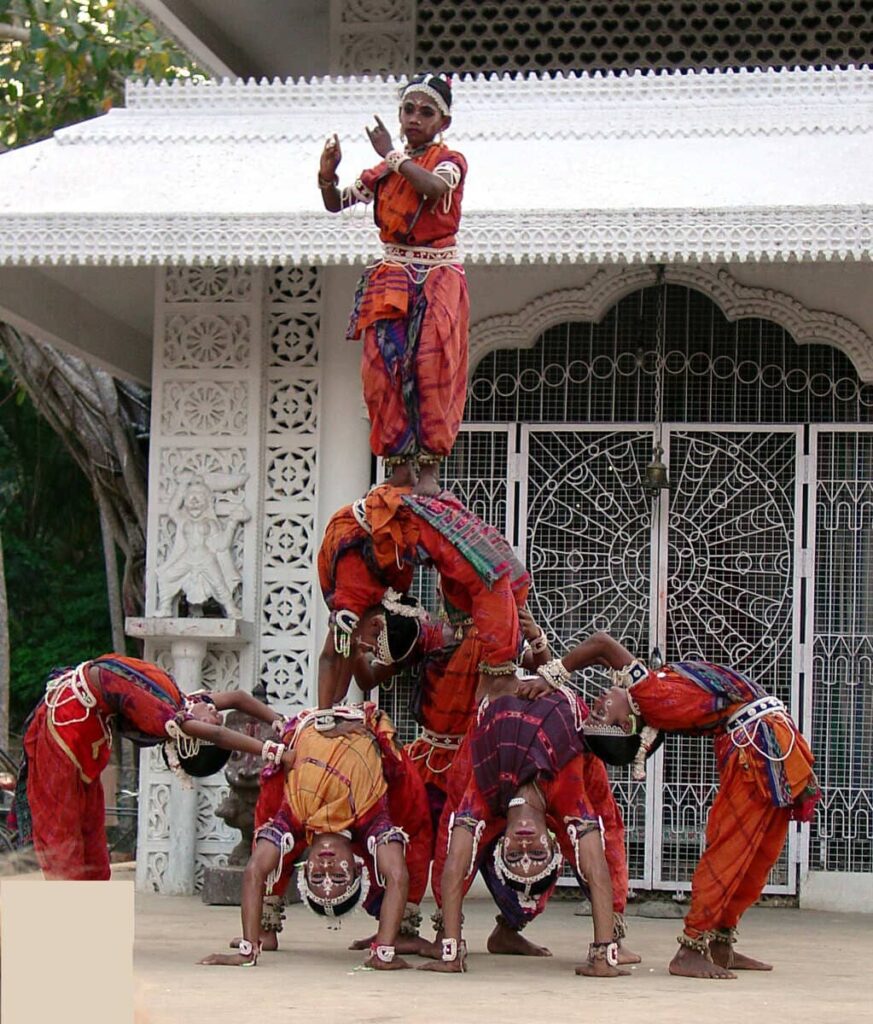
In the Odia language, “Goti” means single and “Pua” means boy. Gotipua is a centuries-old tradition where young boys, beginning their training at around five or six years of age and continuing through adolescence, dress as women to offer acrobatic praises to Lord Jagannath and Lord Krishna.
It is not a theatre. It is not a folk performance in the way most people imagine. It is devotion expressed through the body, with every bend, every leap, and every pose dedicated entirely to the Lord.
Why Do Boys Dress as Women?
This is the question most visitors ask first, and the answer goes much deeper than tradition.
The practice is rooted in Sakhi Bhava, a spiritual philosophy popularised by Sri Chaitanya Mahaprabhu, where the devotee considers themselves a female companion of the Lord as the highest expression of pure, unconditional devotion. There is no ego in Sakhi Bhava. There is only surrender.
When the Mahari tradition of female temple dancers began to decline in the 16th century, young boys stepped in to carry that spirit forward. They took on the feminine form not as imitation but as a continuation of something sacred. That is what my teacher meant all those years ago. The devotion was never about gender. It was always about love for the Lord.
What Is Bandha Nrutya?
The physical heart of Gotipua is Bandha Nrutya, the acrobatic pose sequences that make this dance form unlike anything else you will see in India.
The boys train their bodies to form shapes that represent mythological scenes, chariots, lotus flowers, and figures from the life of Radha and Krishna. These are not simple stretches. They are gravity-defying human sculptures, held with precision and grace by children who have been training since they were barely old enough to read.
The discipline behind it is extraordinary, and it is this very physical and spiritual rigour that directly inspired the birth of classical Odissi dance.
The Connection to Guru Kelucharan Mohapatra
As the artisan and I wrapped up our conversation and stepped back into the lanes, he paused and pointed to one of the houses. “This is Kelu Babu’s house,” he said, with the kind of casual pride that only locals carry.
The house still stands there, just like the rest of the village, unhurried and unassuming. And yet what came out of it changed the entire trajectory of Indian classical dance.
Raghurajpur is the birthplace of Guru Kelucharan Mohapatra, the legendary maestro who was born here in 1926 and went on to take the living folk tradition of Gotipua and shape it into what the world now knows as classical Odissi. That lineage, from a boy growing up in these very lanes to a dance form performed on global stages, began right here among these painted walls.
If you get a chance to catch a live Gotipua practice session at one of the local gurukuls during your visit, do not miss it. The villagers are incredibly proud of this heritage and are almost always welcoming to respectful visitors. It is one of those rare experiences where you are not just watching a performance. You are watching centuries hold themselves together in real time.
What Should You Do When You Visit Raghurajpur?
When you visit Raghurajpur, you should definitely ask the locals or the artisans if you can catch a live practice session.
The villagers are incredibly proud of this heritage and are usually very welcoming to respectful onlookers. Witnessing that high-energy, deeply spiritual performance perfectly complements the static poetry painted on the walls outside.
How To Reach Raghurajpur? (And Why You Should Start From Puri)
When putting together this guide, I assumed you would be traveling to Raghurajpur from Puri. Why?
Because for those of us traveling from Bengal, Puri is practically our second home! It is the classic weekend getaway and the default base camp for any trip to Odisha. Since we all love visiting the Jagannath Temple and spending our evenings by the beach, it makes perfect sense to just squeeze this art village into your existing Puri itinerary.
Because it is located just 10 to 14 kilometers away from the main town, getting there is an absolute breeze. Here is the information you need, along with a few suggestions to make the commute smooth.
There is no entry fee to walk the village. Most workshops are open and welcoming between 9 AM and 6 PM. Plan for at least three to four hours if you want unhurried time in the workshops and a chance to watch a practice session.
The Scenic Drive from Puri
You will love the drive as you leave the crowded temple town behind and enter the lush, palm-fringed countryside. It takes roughly 20 to 30 minutes to reach the village, depending on traffic.
I did this: I simply hired a cab directly from Puri town. Pro tip: You should definitely negotiate a round-trip fare with the driver and ask them to wait for you while you explore. Finding return transport directly from the village on the spot can sometimes be a bit tricky!
Other Ways You Can Do It
- Rent a Scooty: If you enjoy the open road, renting a two-wheeler in Puri is a fantastic idea. It gives you the freedom to stop and take photos along the rural stretches.
- Book a Cab: If you are traveling with family or want a more comfortable AC ride, you can easily book a local taxi from Puri. You should ask your hotel desk to arrange a round-trip cab for a few hours.
- The Highway Detour: If you happen to be driving down the Bhubaneswar-Puri Highway (NH 316) from the airport or railway station, you should keep an eye out for the Chandanpur bazaar junction. From there, you just take a turn, and it is a picturesque 1.5-kilometer narrow road straight into the village.
Trust me, whether you take an auto, a cab, or ride a scooty, making this short trip from Puri is a decision you will love!
When is the Best Time To Visit?
The best time to visit Raghurajpur is during the winter months, when the weather is cool and comfortable—perfect for exploring the village at a relaxed pace. Ideally, plan your trip between late October and early March for the most pleasant experience.
As for the time of day, early evenings around 5 PM offer a beautiful, calm atmosphere as the village winds down and the light turns golden. Alternatively, late mornings between 10 AM and 12 PM are also great, giving you enough time to interact with artisans while everything is active and lively.
Final Suggestions for Your Trip
For those like me, who are travelling from Bengal, an overnight train to Puri is practically a ritual. But stepping away from the usual beach routine to take this short detour adds a completely new layer of depth to the journey.
And if you are coming from other parts of India, reaching this artistic haven is just as easy—simply fly into Bhubaneswar or take a direct train to Puri, and make the quick, scenic drive over.
However you arrive, I highly recommend dedicating at least half a day to Raghurajpur. Hire a local auto or cab from Puri (booking a round-trip is best so they wait for you), keep your camera batteries fully charged to capture the vibrant wall murals, and go with an open mind. It is so much more than a detour; it’s a chance to step into a living museum.
